
Transgender Persons Can Avail Of Already Earmarked Reservati
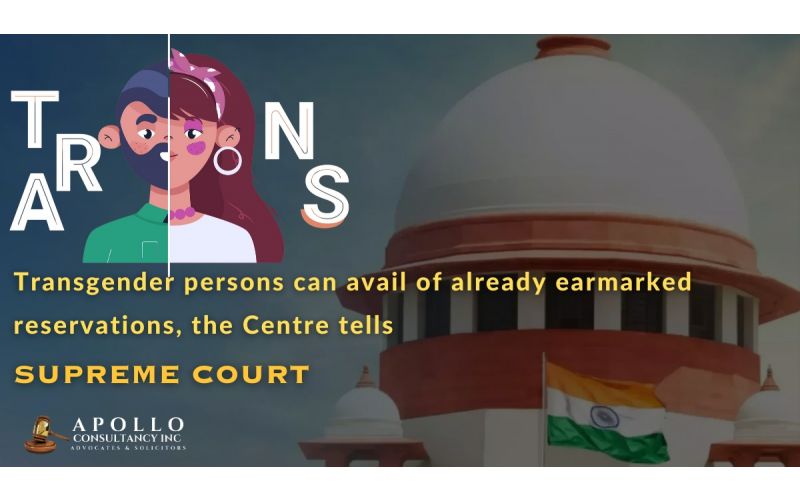
Transgender Persons Can Avail Of Already Earmarked Reservations, The Centre Tells : Supreme Court
|
The Centre has informed the Supreme Court that transgender persons can avail the already earmarked reservations in jobs and educational admissions and there is no separate reservation being provided to them. In 2014, the top court directed the Centre and the state governments to treat transgenders as “socially and educationally backward classes” and extend all kinds of reservation to them in cases of admission in educational institutions and for public appointments. The historical verdict recognised the “third gender” and granted legal recognition to their gender identity.
The Centre has informed the Supreme Court that the transgender persons can avail the already earmarked reservations in jobs and educational admissions and there is no separate reservation being provided to them.
In 2014, the top court directed the Centre and the state governments to treat transgenders as “socially and educationally backward classes” and extend all kinds of reservation to them in cases of admission in educational institutions and for public appointments. The historical verdict recognised the “third gender” and granted legal recognition to their gender identity.
In March this year, the Supreme Court had issued a contempt notice on a petition alleging non-compliance of its order rendered in the landmark case of National Legal Services Authority versus Union of India.
“The benefits of reservation in matters of direct recruitment in Central Government Services and in admission to Central Government Higher Educational Institutions are as follows- Scheduled Castes (SC)- 15%; Scheduled Tribes (ST) – 7.5%; Socially and Educationally Backward Classes (SEBC) – 27%; Economically Weaker Sections (EWS)- 10%. In this regard, it is respectfully submitted that the benefits of any of the reservations including the above four reservations can be availed by the marginalised and eligible population of the country including transgender persons,” said the Centre in its reply.
The affidavit filed by the Secretary in the Union Ministry of Social Justice and Empowerment said that the “transgender belonging to SC/ST/SEBC communities are already entitled to reservations earmarked for these communities.”
Further, it added that any transgender outside the SC/ST/SEBC communities with family income Rs 8 lakh is automatically covered in the EWS category.
The affidavit highlighted the several other steps taken by the Union Government to ameliorate the problems of the transgender community.
It said that a national portal for transgender persons has been launched by the ministry for obtaining transgender certificate of Identity.
Also, a National Council for Transgender Persons has been constituted on August 21, 2020 to advise the government on policies, programmes, legislation and projects with respect to transgender persons.
It stated that recommendations made by an Expert Committee constituted by the ministry were duly incorporated in the Transgender Persons (Protection of Rights) Act, 2019 and the Transgender Persons (Protection of Rights) Rules, 2020.
Post Categories
Featured Posts





Latest Posts








Latest Posts

𝐄𝐦𝐛𝐫𝐚𝐜𝐢𝐧𝐠 𝐋𝐞𝐠𝐚𝐥 𝐓𝐞𝐜𝐡𝐧𝐨𝐥𝐨𝐠𝐲: 𝐈𝐧𝐧𝐨𝐯𝐚𝐭𝐢𝐨𝐧𝐬 𝐒𝐡𝐚𝐩𝐢𝐧𝐠 𝐭𝐡𝐞 𝐅𝐮𝐭𝐮𝐫𝐞 𝐨𝐟 𝐋𝐚𝐰
In today's rapidly evolving digital landscape, the legal industry stands at the precipice of transformation. As advancements in technology redefine the way we work, communicate, and interact, the realm of law is not immune to these revolutionary changes. At Eos ...

Contract Law in the Digital Age: How E-Contracts Are Transforming Legal Agreements
In today's fast-paced, technology-driven world, traditional paper-based contracts are swiftly being replaced by electronic contracts, or e-contracts. This shift is transforming the way legal agreements are created, executed, and enforced. Here’s an in-depth look at how e-contracts are revolutionizing contract ...
Government trying to draft laws in simple manner and in Indian languages: Pm Modi
Prime Minister Narendra Modi emphasized the importance of lawyers and the judiciary in shaping the country's legal system. Prime Minister Narendra Modi expressed his gratitude to the legal fraternity for their substantial contribution to the country's independence movement and its ...

Insurance Companies Must Deal In A Bonafide & Fair Manner ; Should Not Just Care For Its Own Profits : Supreme Court
The Supreme Court observed that an insurance is expected to deal with the insured in a bonafide and fair manner and should not just care for and cater to its own profits. It is the duty of the insurance company ...

AI & the Judiciary: Boundaries and Risks
🧠 Introduction: A New Era for Justice Artificial Intelligence (AI) has rapidly entered almost every professional domain — and the legal world is no exception. From predictive analytics to legal research automation, AI is revolutionizing how lawyers, judges, and courts ...

Repatriation of Funds and Investments: Legal Guidelines for NRIs
For Non-Resident Indians (NRIs), repatriating funds and investments back to their country of residence is a crucial aspect of financial management. However, navigating the legal landscape can be complex. Here are essential guidelines NRIs should follow to ensure smooth and ...

Speak With Our
Get a Appointment