
CJI DY Chandrachud Cautions About Artificial Intelligence; S
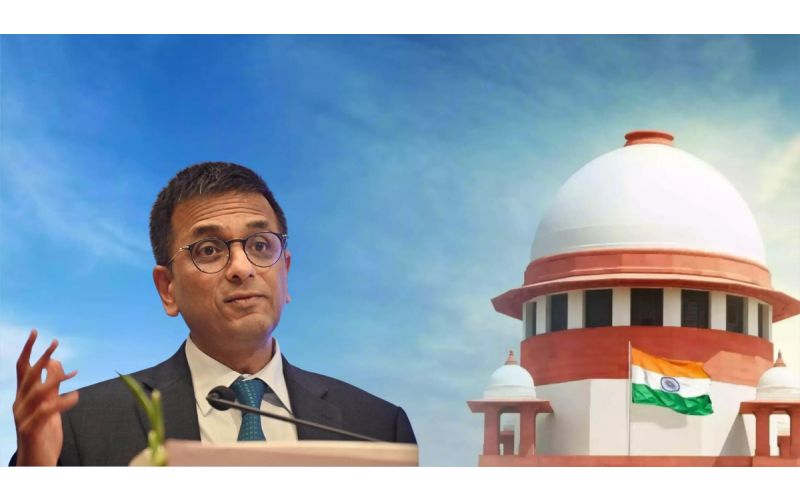
CJI DY Chandrachud Cautions About Artificial Intelligence; Says It Can Make Biased Decisions Based On Societal Prejudices
|
Chief Justice of India D Y Chandrachud
recently spoke on how no technology is neutral and how it can reflect human values when deployed in the real world. The CJI spoke on how one must ponder the human and societal values that technology represents, especially the context in which they are deployed. “
This is because technology doesn’t develop in a social vacuum. They take place inside an intricate tapestry of societal realities and legal, economic and political structures
CJI DY Chandrachud, speaking at the 60th Convocation Ceremony of Indian Institute of Technology (IIT) Madras, explained how Artificial Intelligence, which has immense potential but can also be used to perpetuate discrimination and unfair treatment:
“A significant impact of AI is its potential to amplify discrimination and undermine the right to fair treatment. Many AI systems have been shown to exhibit biased decision making based on data inputs that reflect societal prejudices. For example, AI recruitment tools deployed by firms favoured men over women because the tools were trained on profile of successful employees who, for gendered reasons, happened to be predominantly male. In this, data driven systems can perpetuate biases and marginalise the social control mechanisms that govern human behaviour.
According to the Chief Justice, the real redemption of technology lies in enabling freedoms and human rights of every individual. Technology has the ability to make us resilient to future threats that loom over future freedoms, he said.
He also expressed concern about how AI has the potential to be misused to bullying, threatening and misleading:
Today Artificial Intelligence are the two words on everybody’s lips. AI is being deployed rapidly to enhance the efficiency of computer software and hardware. In a relatively short time, AI tools such as ChatGPT has shown that even computer can crack a joke, write codes or even draft legal memos. Even in the Supreme Court, we are using AI on a pilot basis for live transcriptions of court proceedings. The trepidations voiced by many about the advent of AI is an example of how new technologies do not exist in a vacuum. Always keep in mind what values AI represents and what affordances it creates. I have personally been fascinated with the AI image-generating software, which allows you to put in a written prompt and generate an image, but I am also cognisant of its potential misuse to create deep fakes, to mislead and to bully individuals.”
The Chief Justice spoke on the power of science and technology to attain human rights and liberty. According to him every incremental change in technology has the potential to transform the lives of individuals, bridge societal divides and secure justice. But new technology can also facilitate unintended behaviours, the CJI opined. In this context, he spoke on the threat of surveillance through technology:
“With the advent of emails you may never know that your email is being intercepted and this can now be done at an unprecedented scale. Thus, while electronic communication shows values of communication and collaboration they also create the possibility of mass surveillance of our most intimate details and ideas. Privacy, confidentiality, security, transparency and anonymity are some of the basic expectations people have from technology they use. Both technology and law have striven to secure this. We all want our messages to now be end-to-end encrypted and this shows how every new technology creates new affordances which in turn modify human behaviour and lead to new technology,’ he said.
Chief Justice Chandrachud, also spoke about how technology transformed the judicial system. It has facilitated access to justice and can also help keep citizens better informed:
“During the Covid-19 pandemic the Supreme Court introduced the virtual court system which till date allows litigants and lawyers from outside Delhi to appear before the Supreme Court. Courts across India held as many as 43 million hearings. These millions of hearings made us realise how Virtual Courts have helped female lawyers who otherwise faced difficulty in appearing in court due to the gendered demands of domestic work and caregiving. With VCs they could argue from their homes. VC also facilitated the live-streaming of Constitution bench proceedings, which has helped citizens stay informed about on-going cases. The values of video-conference extend beyond mere communication and collaboration to encompass inclusivity and access to justice.’ the CJI Explained.
The CJI also spoke on the interplay of law and technology in facilitating progress:
It is often said technology develops at a speed with which the law cannot keep up with. This may seem true in the heat of the moment, but if we take a step back, our history would be a testament to the fact that law and technological developments share a dialectic relationship. They speak to speak to one another constantly, each one pushing the other forward. At one point in time in history, ships were considered the pinnacle of modern technology but with every voyage came a risk of losing all your goods and human lives to the high seas. It was the law of corporate ownership and financing that allowed businesses to manage the risk of overseas voyages leading to first generation of entrepreneurs and venture capitalists. Later it was the rapid technological evolution of the industrial revolution that led to the development of labour law and patent law.
Post Categories
Featured Posts








Latest Posts








Latest Posts

🏠 𝐋𝐞𝐠𝐚𝐥 𝐂𝐡𝐞𝐜𝐤𝐥𝐢𝐬𝐭 𝐁𝐞𝐟𝐨𝐫𝐞 𝐈𝐧𝐯𝐞𝐬𝐭𝐢𝐧𝐠 𝐢𝐧 𝐈𝐧𝐝𝐢𝐚𝐧 𝐑𝐞𝐚𝐥 𝐄𝐬𝐭𝐚𝐭𝐞 (2025 𝐄𝐝𝐢𝐭𝐢𝐨𝐧)
𝐍𝐑𝐈 𝐨𝐫 𝐇𝐍𝐈? 𝐃𝐨𝐧’𝐭 𝐈𝐧𝐯𝐞𝐬𝐭 𝐖𝐢𝐭𝐡𝐨𝐮𝐭 𝐓𝐡𝐞𝐬𝐞 7 𝐋𝐞𝐠𝐚𝐥 𝐂𝐡𝐞𝐜𝐤𝐬! Real estate remains one of the most trusted investment avenues for 𝐍𝐑𝐈𝐬 𝐚𝐧𝐝 𝐇𝐍𝐈𝐬 𝐢𝐧 𝐈𝐧𝐝𝐢𝐚. But with rising frauds, title disputes, and compliance issues—a beautiful property can become a ...
AI & the Judiciary: Boundaries and Risks
🧠 Introduction: A New Era for Justice Artificial Intelligence (AI) has rapidly entered almost every professional domain — and the legal world is no exception. From predictive analytics to legal research automation, AI is revolutionizing how lawyers, judges, and courts ...

Judicial Decorum vs. Legal Expression: Balancing Dissent with Discipline in India’s Courtrooms
🏛️ The Incident That Sparked a National Conversation The recent events in the Supreme Court of India have reignited a fundamental debate — where does a lawyer’s right to expression end and duty to maintain decorum begin? A courtroom is ...

5 Mistakes People Make While Buying Property in India
Buying property is one of the biggest financial decisions in India.But are you sure you are not making a mistake that could cost you years of litigation or financial loss? Many buyers focus only on location and price, while ignoring ...
Understanding Indian Constitutional Laws: A Brief Overview
Introduction: Indian Constitutional Law is the backbone of the country's legal system, laying down the framework for governance, rights, and duties of citizens, and the functioning of various institutions. Enshrined in the Constitution of India, adopted on January 26, 1950, ...

"Why Are You Being So Patriarchal?" : Supreme Court Asks Centre Over Denial Of Permanent Commission To Woman Coast Guard Officer
The Supreme Court on Monday (February 19) pulled up the Central Government over the denial of Permanent Commission for women officers in the Indian Coast Guard (ICG). The bench led by Chief Justice of India DY Chandrachud, hearing a plea of ...

Speak With Our
Get a Appointment