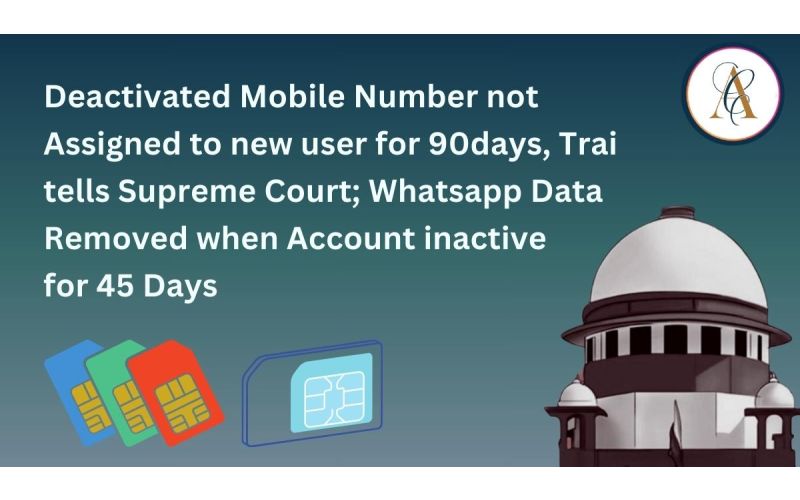
The Telecom Regulatory Authority of India (TRAI) has told the Supreme Court that once a cellular mobile telephone number is deactivated for non-usage or disconnected on the request of the subscriber, it is not allocated to a new subscriber for at least a period of 90 days.
A bench of A bench of Justice Sanjiv Khanna and Justice SVN Bhatti observed that it is for the earlier subscriber to take adequate steps to ensure that privacy is maintained.
The Court also said that a subscriber can prevent misuse of WhatsApp data by deleting their WhatsApp account attached with the previous phone number and erasing the WhatsApp data stored on the local device memory/cloud/drive.
WhatsApp informed the Court that in case of re-cycled phone numbers, WhatsApp monitors account inactivity. When an account is inactive for 45 days and then the account is activated on a different mobile device, the old account data is removed.
Recording these observations, the Court disposed of a writ petition filed in 2021 which raised concerns about misuse of mobile numbers after they are disconnected or deactivated.
The rapid proliferation of digital technologies has transformed India’s social, economic, and professional landscape. While digitalization brings efficiency and innovation, it also exposes individuals and businesses to cybercrime risks. As a lawyer in India, it is crucial to understand the ...
The Supreme Court has said a five-judge constitution bench will examine whether Parliament can “abrogate the constitutional principles of governance” for the Delhi government by making a law to take away its control over services. The Centre recently issued an ...
Dear community In the ever-evolving landscape of dispute resolution, the demand for faster and more efficient solutions is on the rise. As businesses and individuals seek alternatives to protracted litigation, arbitration has emerged as a compelling choice. Let's delve into ...
YES! 🚫 𝐎𝐧𝐥𝐲 𝐢𝐧 𝐞𝐱𝐜𝐞𝐩𝐭𝐢𝐨𝐧𝐚𝐥 𝐜𝐚𝐬𝐞𝐬 — like proven misconduct, criminal activity, or if the employment contract specifically permits termination without notice. 🧾 𝐔𝐧𝐝𝐞𝐫 𝐭𝐡𝐞 𝐈𝐧𝐝𝐮𝐬𝐭𝐫𝐢𝐚𝐥 𝐃𝐢𝐬𝐩𝐮𝐭𝐞𝐬 𝐀𝐜𝐭, 1947, and state-specific Shops & Establishment Acts, arbitrary dismissal can invite legal ...
Lamenting the long delay in the execution of decrees, the Supreme Court observed that under Section 47 of the Code of Civil Procedure, the Executing Court can only go into questions that are limited to the execution of decree and ...
The Supreme Court on Friday refused to entertain a Public Interest Litigation (PIL) seeking an independent audit of source codes of Electronic Voting Machines (EVMs). The bench comprising CJI DY Chandrachud, Justice JB Pardiwala, and Justice Manoj Misra noted that ...