
India's Tougher Anti-Paper Leak Law-A Step Towards Protectin
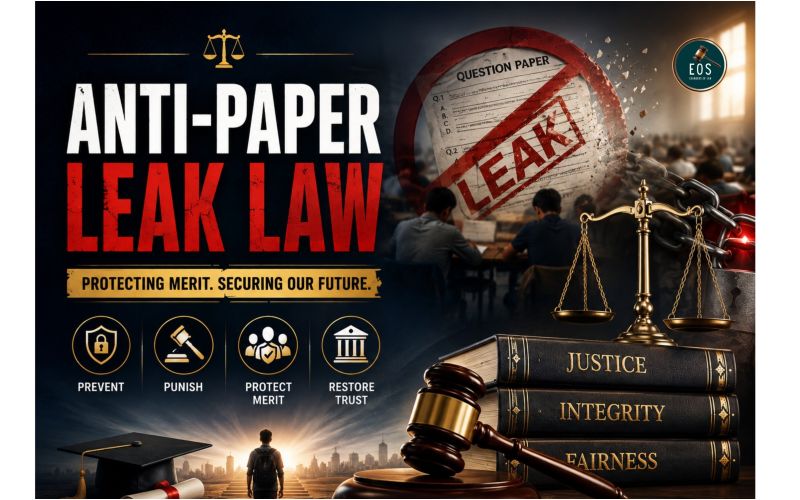
India's Tougher Anti-Paper Leak Law-A Step Towards Protecting Merit and Restoring Public Trust
|
A Legal Perspective on the Public Examinations (Prevention of Unfair Means) Amendment Act, 2026
For millions of students across India, a public examination is far more than a test—it represents years of dedication, family sacrifices, and aspirations for a better future.
When the integrity of such examinations is compromised through paper leaks or organized cheating, the consequences extend well beyond a single examination. They undermine public confidence, weaken meritocracy, and challenge the very principles of fairness upon which a democratic society is built.
Recognizing the growing concern over recurring examination malpractices, Parliament has strengthened the legal framework through the Public Examinations (Prevention of Unfair Means) Amendment Act, 2026, introducing stricter penalties, faster investigations, and specialized mechanisms to combat organized examination fraud.
Why Was a Stronger Law Needed?
In recent years, India witnessed several controversies involving alleged paper leaks in competitive and recruitment examinations. These incidents not only delayed recruitment and admissions but also deeply affected the confidence of lakhs of deserving candidates.
A single paper leak has consequences that extend beyond the examination hall.
It affects:
- Students who prepare for years.
- Families who invest significant financial resources.
- Educational institutions.
- Public recruitment processes.
- Society's confidence in equal opportunity.
Merit loses its meaning when unfair means replace honest effort.
What Does the Amendment Aim to Achieve?
The 2026 Amendment strengthens the Public Examinations (Prevention of Unfair Means) Act, 2024 by introducing a more robust enforcement mechanism against organized examination fraud.
Its objectives include:
- Protecting the integrity of public examinations.
- Deterring organized paper leak syndicates.
- Ensuring time-bound investigation.
- Providing speedy trials through Special Fast Track Courts.
- Restoring public confidence in examination systems.
The legislation recognizes that examination fraud is no longer an isolated misconduct but often involves organized networks using technology and financial incentives.
Key Legal Changes
The Amendment introduces several significant reforms.
1. Enhanced Punishments
The law substantially increases imprisonment terms and financial penalties for individuals, service providers, and organized criminal networks involved in examination fraud. In serious organized crime cases, the minimum punishment has been increased, accompanied by significantly higher fines.
2. Fast-Track Investigation and Trial
One of the most notable features is the introduction of:
- Time-bound investigations,
- Special Fast Track Courts,
- Special Public Prosecutors,
- Expedited appeals.
The objective is to ensure that examination-related offenses are resolved without prolonged litigation, thereby strengthening deterrence.
3. Stronger Action Against Organized Crime
The amendment targets not merely individual offenders but also organized networks, institutions, and service providers involved in facilitating unfair means.
This reflects an important shift from punishing isolated misconduct to dismantling organized examination fraud.
Constitutional Perspective
The Constitution of India guarantees equality before law under Article 14 and protects the right to life and personal liberty under Article 21, which has been judicially interpreted to include fairness in State action.
Public examinations conducted by government authorities must therefore satisfy constitutional standards of:
- fairness,
- transparency,
- equal opportunity, and
- non-arbitrariness.
When examination integrity is compromised, it directly impacts these constitutional values.
Protecting merit is not merely an administrative objective—it is a constitutional obligation.
Will Stricter Punishments Alone Solve the Problem?
Stronger penalties undoubtedly enhance deterrence.
However, sustainable reform requires more than criminal sanctions.
Long-term improvement also depends upon:
- Secure digital examination infrastructure.
- Robust cybersecurity.
- Greater institutional accountability.
- Advanced monitoring systems.
- Transparent examination processes.
- Regular audits of examination authorities.
Law can punish misconduct.
Good governance prevents it.
Restoring Public Confidence
The greatest objective of this legislation is not merely increasing punishments.
It is restoring public trust.
Students should enter examination halls with confidence that:
- every candidate competes fairly,
- merit alone determines success,
- the system rewards honest effort,
- and opportunities cannot be purchased through organized malpractice.
A credible examination system strengthens confidence not only in education but also in public institutions.
The Way Forward
India's education and recruitment systems continue to evolve alongside technological advancements.
The 2026 Amendment represents a significant legislative response to one of the most pressing challenges confronting public examinations.
Its success, however, will ultimately depend upon effective implementation, institutional vigilance, technological safeguards, and strict enforcement of the law.
A robust legal framework is an important beginning.
Consistent execution will determine its lasting impact.
Conclusion
Education remains one of the most powerful instruments of social mobility.
Every deserving student has the right to compete in an environment governed by fairness, transparency, and merit.
The Public Examinations (Prevention of Unfair Means) Amendment Act, 2026 sends a strong message that organized examination fraud will not be tolerated and that the integrity of public examinations is a matter of national importance.
As India continues to strengthen its education and recruitment systems, one principle must remain unwavering:
The credibility of a nation's future depends upon the integrity of its examinations.
Post Categories
Featured Posts



Latest Posts








Latest Posts
An In-Depth Look at Environmental and Sustainability Law
In today's rapidly changing world, environmental and sustainability law has become a cornerstone of global legal practices. With increasing awareness of climate change, resource depletion, and environmental degradation, these laws are essential for promoting sustainable development and protecting our planet ...
Children Of Invalid Marriages Have Right In Their Parents’ Share In Hindu Joint Family Property : Supreme Court
The Supreme Court on Friday (September 1) pronounced a judgment recognizing the rights of children born out of invalid marriages in their parents’ share in Hindu joint family property. The Court held that children born out of void/voidable marriages are ...
Insurance Companies Must Deal In A Bonafide & Fair Manner ; Should Not Just Care For Its Own Profits : Supreme Court
The Supreme Court observed that an insurance is expected to deal with the insured in a bonafide and fair manner and should not just care for and cater to its own profits. It is the duty of the insurance company ...
Petition Against IIT Eligibility Criteria Of 75% In Class 12 Dismissed
A vacation bench of Justices Sudhanshu Dhulia and K V Vishwanathan said this prerequisite existed earlier as well and it was not inclined to intervene in the matter. New Delhi: The Supreme Court on Monday dismissed a plea challenging the ...
Row Over Services: Will Examine If Parliament Can Abrogate Constitutional Principles Of Governance For Delhi, Says Supreme Court
The Supreme Court has said a five-judge constitution bench will examine whether Parliament can “abrogate the constitutional principles of governance” for the Delhi government by making a law to take away its control over services. The Centre recently issued an ...
'Hurried Trial' : Supreme Court Sets Aside Death Penalty Given In Child Rape-Murder Case Within 23 Days; Orders Fresh Trial
The Supreme Court on Thursday (October 19) set aside the conviction and death sentence of a man accused of kidnapping, raping, and murdering a three-month-old infant after noting that he had not been give a 'proper opportunity' to defend himself. ...

Speak With Our
Get a Appointment