
Cross-Border Succession Planning: What Global Indian Familie

Cross-Border Succession Planning: What Global Indian Families Must Fix in 2026
|
Protecting Wealth Across Borders Requires More Than Just a Will.
Global Indian families are increasingly building wealth beyond geographical boundaries. A business in India, investment portfolios in the UAE, real estate in the UK, children settled in the United States, and financial assets spread across multiple jurisdictions have become increasingly common.
While wealth has become global, succession planning often remains local.
Unfortunately, many families discover the legal complexities of cross-border inheritance only after the demise or incapacity of a family member. At that stage, what should have been a smooth transfer of assets often turns into lengthy legal proceedings, conflicting jurisdictional requirements, tax concerns, and family disputes.
Effective succession planning is no longer just about preparing a Will. It is about creating a legally structured framework that protects wealth across jurisdictions while ensuring the wishes of the family are respected.
Why Cross-Border Succession Planning Matters
Unlike domestic estate planning, cross-border succession involves multiple legal systems.
Different countries have different laws relating to:
- Recognition of Wills
- Probate procedures
- Forced heirship rules
- Matrimonial property rights
- Trust structures
- Ownership of overseas assets
- Taxation of inherited property
A succession plan that works perfectly in one country may not automatically be recognised in another.
For families with international assets, this can create uncertainty at the most difficult time.
Common Mistakes Global Indian Families Make
1. Assuming One Will Covers Everything
Many individuals prepare a Will in India believing it governs their worldwide assets.
However, certain jurisdictions require separate probate procedures, while others may have different formal requirements for recognising foreign Wills.
Without proper planning, beneficiaries may face unnecessary delays and legal complications.
2. Ignoring Overseas Assets
Foreign bank accounts.
International investments.
Overseas real estate.
Private companies.
Digital assets.
These are often overlooked during succession planning.
Incomplete disclosure of assets frequently results in avoidable disputes and prolonged administration.
3. Delaying Succession Planning Until It Is Too Late
Many successful entrepreneurs spend decades creating wealth but postpone succession discussions.
Unexpected events rarely provide advance notice.
Proper planning is most effective when undertaken well before it becomes necessary.
4. No Clear Family Governance Structure
For business families, succession is about much more than inheritance.
Questions often arise regarding:
- Business ownership
- Voting rights
- Decision-making authority
- Management succession
- Shareholding transfers
Without documented governance mechanisms, disagreements can quickly escalate into litigation.
5. Failing to Update Existing Estate Plans
Marriage.
Children.
International relocation.
Business expansion.
Acquisition of overseas property.
Every major life event should trigger a review of succession documents.
An outdated estate plan may no longer reflect current family or commercial realities.
The Role of Trusts in Wealth Preservation
For many HNIs and business families, trusts can play an important role in succession planning.
When appropriately structured, trusts may assist with:
- Asset protection
- Continuity of family wealth
- Structured succession
- Protection of vulnerable beneficiaries
- Long-term governance objectives
However, every structure must be evaluated in light of applicable legal and regulatory requirements.
Family Businesses Need a Succession Strategy—Not Just a Successor
One of the greatest risks to a successful business is the absence of a documented succession plan.
Without clarity, future generations may inherit conflict instead of opportunity.
A well-designed succession framework helps ensure continuity of leadership, stability of ownership, and preservation of business value.
A Practical Cross-Border Succession Checklist
Global Indian families should periodically review:
✔ Wills and estate planning documents
✔ Overseas asset inventory
✔ Ownership structures
✔ Business succession arrangements
✔ Shareholding documentation
✔ Powers of Attorney
✔ Nomination records
✔ Trust structures, where appropriate
✔ Family governance mechanisms
✔ Cross-border legal and regulatory implications
The Cost of Waiting
Succession planning is often postponed because it is perceived as uncomfortable.
Yet delaying these conversations can expose families to:
- Lengthy probate proceedings
- Jurisdictional conflicts
- Asset transfer delays
- Business disruption
- Family disputes
- Significant legal expenses
Planning early provides certainty—not only for assets, but for future generations.
EOS Chambers Perspective
At EOS Chambers of Law, we recognise that succession planning extends beyond legal documentation. It is about preserving legacy, protecting family wealth, and ensuring continuity across generations.
Our approach focuses on developing legally sound and commercially practical succession strategies that take into account family dynamics, business interests, and cross-border legal considerations.
In an increasingly global world, wealth deserves a strategy that is equally global.
Conclusion
The true measure of successful wealth creation is not only how it is built—but how seamlessly it is transferred to the next generation.
For global Indian families, cross-border succession planning is no longer optional. It is an essential part of responsible wealth management.
A legacy is not protected by intention alone—it is protected by careful planning.
Post Categories
Featured Posts








Latest Posts








Latest Posts

Muzaffarnagar slapping case: SC pulls up UP govt over delay in student counselling
After perusing the state reply Friday, the bench said it reflected that the counselling process had not been done yet. “It is not reflected, it is not being done,” said Justice Oka. The Supreme Court Friday pulled up the Uttar ...

Indian Penal Code
The Indian Penal Code (IPC) is the official criminal code of India. It is a comprehensive code intended to cover all substantive aspects of criminal law. The code was drafted on the recommendations of the first law commission of India ...

Buyer Not Complying With Timeline For Payment Can't Seek Specific Performance Of Agreement To Sell : Supreme Court
The Supreme Court in a recent decision held that when a contract stipulates a specific time frame within which the consideration needs to be paid by the 'buyer' to execute the 'agreement to sale' by the 'seller', then the buyer ...

Navigating the Complexities of Corporate & Commercial Laws: Key Considerations for Businesses
In today's dynamic business landscape, understanding and complying with corporate and commercial laws are paramount for organizations aiming to thrive and expand. From formation and governance to contractual relationships and regulatory compliance, adherence to legal frameworks is essential for maintaining ...
Recruitment Process -Last Date To Fulfil Eligibility Criteria Is Last Date To Submit Applications, In The Absence Of Any Specific Rule: Supreme Court
The Supreme Court emphasized that where there is an absence of any specific rule or prescription, the last day for fulfilling eligibility is the last date of submission of the application. The Court made the observation while refusing the benefit ...
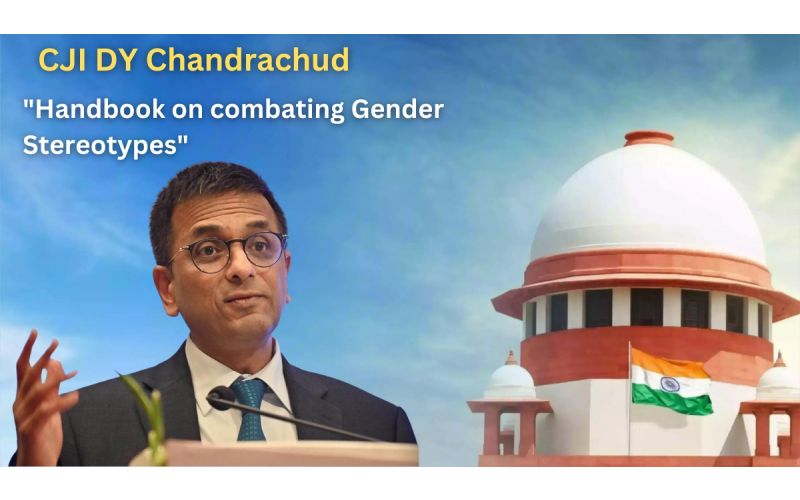
Supreme Court Has Prepared A “Handbook On Combating Gender Stereotypes”
Chief Justice of India DY Chandrachud announced today morning that the Supreme Court has prepared a “Handbook on combating Gender Stereotypes”, in order to identify and remove the use of words and phrases, which are loaded with gender stereotypes, in ...

Speak With Our
Get a Appointment