Grant Of Bail Can't Be Made Dependent On Surrender Of Co-Acc

Card image

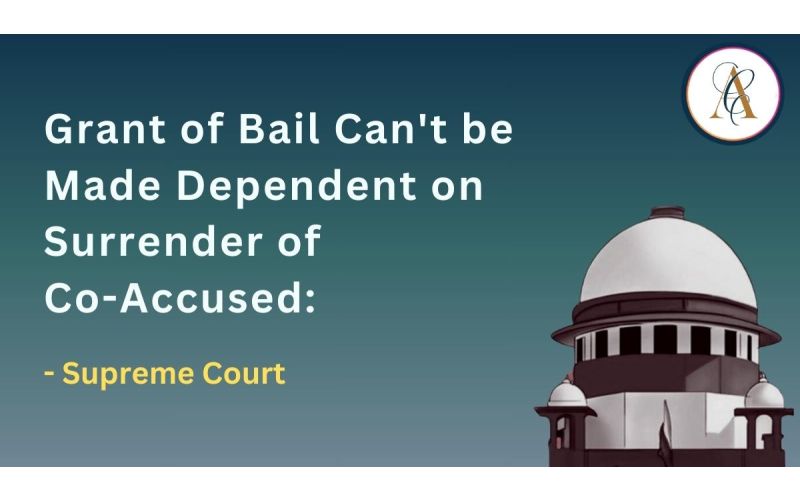
Grant Of Bail Can't Be Made Dependent On Surrender Of Co-Accused : Supreme Court

By Team EOS |

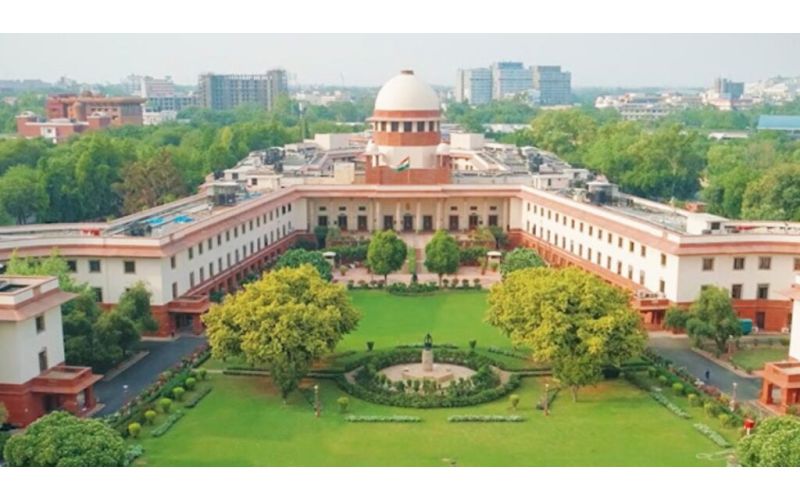
A Division Bench of the Supreme Court, while allowing a bail plea, held that the grant of bail to a co-accused person cannot be contingent on the surrender of another accused who is also pertinently the main accused in the case.

“In our opinion, the question of grant of bail to a co-accused person cannot made dependent upon surrender of another accused who is described as the main accused person in this case.,” the Court held. 

The Bench of Justices Aniruddha Bose and Bela M. Trivedi made these observations while deciding a bail of plea of an accused in a dowry death case. It is important to note that the appellant is the brother of the husband and also an accused. It may also be noted that the husband has been absconding and the trial had begun without he being arrested.

Prior to approaching the Supreme Court, the appellant approached the Patna High Court seeking his grant of bail. The High Court, in its impugned judgment , though directed for release of the petitioner on bail however, the same was linked to the condition of surrender by the husband of the deceased before the learned trial court. The relevant portion of the order is:

I deem it fit and proper to direct for release of the petitioner on bail, immediately upon surrender by the husband of the deceased victim lady before the learned trial court, subject to such conditions as may be deemed fit and proper to be imposed by the learned court of Judicial Magistrate-1st Class, Buxar in connection with Koran Sarai P.S.Case No. 18 of 2021."

The Top Court, while allowing the bail plea, observed that imposition and subsequent adhering to the condition of surrender of the husband of the deceased/ co-accused would not be necessary for grant of bail to the appellant. 
Latest News Latest Supreme Court

Latest Posts

Card image

Section 313 CrPC | 'Right To Remain Silent Not Be Used Against Accused' : Supreme Court Summarises 12 Principles

Recently, the Supreme Court, in a noteworthy judgment, while acquitting a woman accused of killing her own child and was convicted for murder and sentenced to life imprisonment, also decided the question of what may be required of the convict ...

Card image

Stubble Burning One Reason For Delhi Air Pollution, Says CAQM; Supreme Court Seeks Affidavits From Punjab, Haryana, UP, Rajasthan

The Supreme Court on Tuesday (October 31) asked the Governments of Punjab, Haryana, Uttar Pradesh, Rajasthan and Delhi to file affidavits setting forth the steps they have taken to control air pollution including the measures to curb crop burning. This ...

Card image

Corporate Social Responsibility and Legal Obligations - Navigating the Legal Aspects of CSR Initiatives

Corporate Social Responsibility (CSR) has evolved from a voluntary initiative to a crucial component of modern business strategy. In today's globalized economy, companies are expected to contribute positively to society while maintaining profitability. However, CSR is not just about corporate ...

Card image

E-Courts: The Future of Judiciary in India

India’s judiciary is at a crossroads, with digitization and judicial reforms paving the way for increased efficiency, transparency, and accessibility. The e-Courts initiative, launched by the Indian judiciary under the National e-Governance Plan (NeGP), is a transformative step toward modernizing ...

Card image

Startups and Legal Compliance: A Guide to Navigating Indian Laws

Navigating legal compliance is crucial for startups to establish a strong foundation and ensure sustainable growth. In India, understanding and adhering to applicable laws can be complex but essential. Here’s a concise guide to help startups stay compliant: 1. Incorporation ...

Card image

Understanding Indian Constitutional Laws: A Brief Overview

Introduction: Indian Constitutional Law is the backbone of the country's legal system, laying down the framework for governance, rights, and duties of citizens, and the functioning of various institutions. Enshrined in the Constitution of India, adopted on January 26, 1950, ...

EOS Chambers of Law

Speak With Our
Experts Today!

Get a Appointment
EOS Chambers of Law