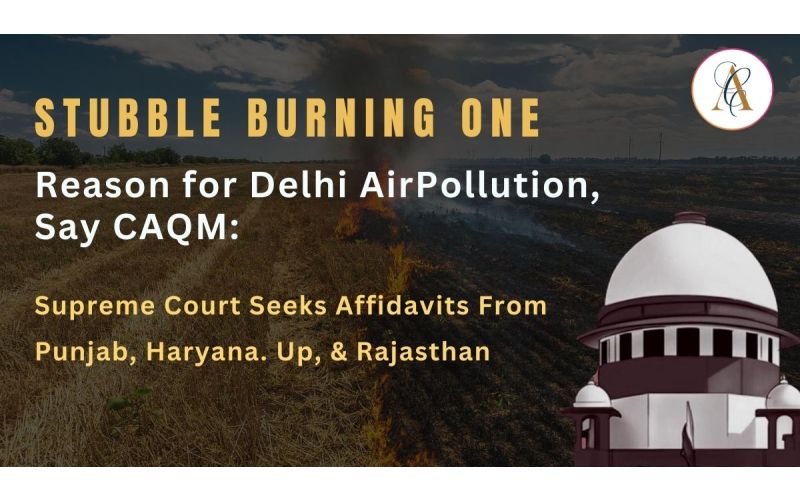
The Supreme Court on Tuesday (October 31) asked the Governments of Punjab, Haryana, Uttar Pradesh, Rajasthan and Delhi to file affidavits setting forth the steps they have taken to control air pollution including the measures to curb crop burning.
This was after the Commission for the Air Quality Management (CAQM) stated in its report submitted to the Court that one of the reasons for the air pollution in the National Capital Region was stubble burning.
A bench comprising Justices Sanjay Kishan Kaul and Sudhanshu Dhulia observed in the order :
“The status report has been filed on behalf of the Commission for Air Quality Management in compliance of the order dated 10.10.2023. The report is comprehensive, but the problem of the air quality still persists. One of the issues flagged is of crop burning. Ld. Amicus suggests that the concerned states should an affidavit setting forth the steps they have taken to redeem the position…. we call upon the state of Punjab, Haryana, UP, Rajasthan and Delhi to file their affidavits within a week…Commission will also state before us in a tabular form the result for the relevant period which is when the problem starts till one day before next date.”
During today’s hearing, the Union submitted that the report of CAQM dealt with the eight sources of pollution, and it also mentioned the steps that have been taken in that regard. Further, it also included the tables comparing the position of last two-three years and today.
Justice Kaul asked about the air quality impact and told the Union that all these steps are on paper. “The point is on ground reality what is happening? Whatever happens the air quality does not improve”.
Introduction: Why PE Risk Is a Serious Compliance Issue in 2026 India continues to witness heightened scrutiny of foreign companies operating through subsidiaries, employees, consultants, and digital presence. With increased data sharing, GST intelligence, and income-tax investigations, Permanent Establishment (PE) ...
Introduction: As remote work continues to redefine the modern workplace, it brings with it a host of legal considerations that businesses and employees must navigate. From data protection to employment law and contractual obligations, the shift to remote work presents ...
Index: Introduction Understanding Criminal Offences 2.1 Petty Offences 2.2 Cognizable Offences 2.3 Non-Cognizable Offences Consequences of Criminal Offences 3.1 Legal Consequences 3.2 Social and Personal Impact 3.3 Societal Costs Conclusion———————————— Introduction: Criminal offenses encapsulate acts that transgress established laws and regulations, warranting punitive measures imposed ...
A Legal Perspective on the Public Examinations (Prevention of Unfair Means) Amendment Act, 2026 For millions of students across India, a public examination is far more than a test—it represents years of dedication, family sacrifices, and aspirations for a better ...
The Supreme Court has held that if an Indian Entity’s Establishment is operating in Oman and has a ‘Permanent Establishment’ status under Double Taxation Avoidance Agreement (“DTAA”), then the dividend income received by the Indian Entity from such Establishment would ...
Ahead of the festive season, the Supreme Court on Wednesday said that it would not interfere with a decision of a state government if it decides to impose a complete ban on firecrackers, including green crackers, to check pollution level ...