
Supreme Court Has Prepared A “Handbook On Combating Gender
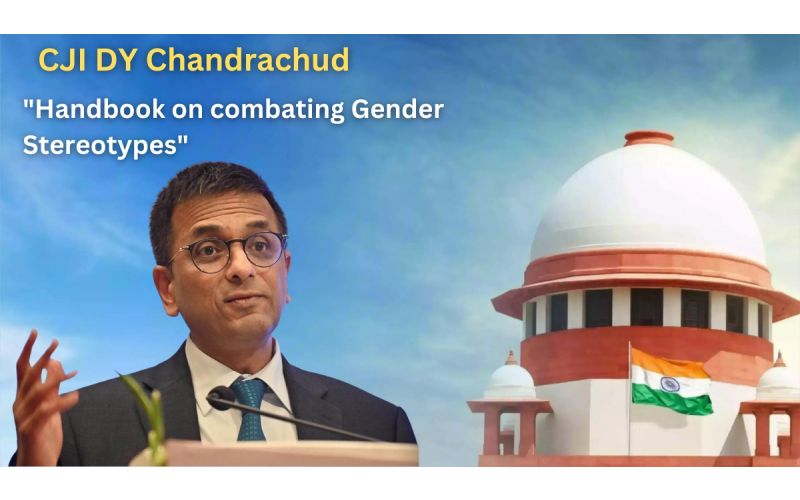
Supreme Court Has Prepared A “Handbook On Combating Gender Stereotypes”
|
Chief Justice of India DY Chandrachud announced today morning that the Supreme Court has prepared a “Handbook on combating Gender Stereotypes”, in order to identify and remove the use of words and phrases, which are loaded with gender stereotypes, in judgments and court language.
“This is to assist judges and the legal community to identify, understand, and combat stereotypes about women in legal discourse. It contains a glossary of gender unjust terms and suggests alternative words and phrases which may be used while drafting pleadings as well as orders and judgements. It is for lawyers as well as judges”, CJI said.
“The handbook identifies common stereotypes by women, many of which have been utilised by courts in the past and demonstrates why they’re inaccurate and how they may distort the application of law. The intention is not to criticize or cast doubts on judgements but merely to show how stereotypes may unwittingly employed. To raise awareness against the utilisation of harmful stereotypes, particularly those against women, the handbook aims to explain what stereotypes are”, CJI added.
“It helps judges identify and avoid such stereotypes by first- identifying language which promotes gender stereotypes and offering alternative words and phrases; two, identifying common reasoning patterns based on gender stereotypes particularly about women. And three, highlighting binding judgements of Supreme Court which have rejected these stereotypes”, CJI explained.
The handbook will be uploaded in the Supreme Court website shortly.
While speaking at a public event in March this year, CJI Chandrachud had revealed that the handbook on gender stereotypes was under preparation. ““For instance, I have come across judgments which have referred to a woman as a ‘concubine’ when she is in a relationship. Women have been called ‘keeps’ in judgements where there were applications for quashing of FIRs under the Domestic Violence Act and Section 498A of the Indian Penal Code”, CJI
The legal glossary, Chief Justice Chandrachud then, was prepared by a committee chaired by Calcutta High Court judge Moushumi Bhattacharya. Other people involved in the process included Delhi High Court Judge Justice Prathiba M. Singh, former judges Prabha Sridevan and Gita Mittal, and Jhuma Sen, Advocate, Calcutta High Court and Supreme Court, also an adjunct faculty member at the West Bengal National University of Juridical Sciences in Kolkata.
Source
Post Categories
Featured Posts





Latest Posts








Latest Posts

Won’t interfere with firecracker ban in Delhi: SC
Ahead of the festive season, the Supreme Court on Wednesday said that it would not interfere with a decision of a state government if it decides to impose a complete ban on firecrackers, including green crackers, to check pollution level ...
EVMs Non-Tamperable, Demand For 100% VVPAT Verification Regressive: Election Commission Tells Supreme Court
Ahead of the 2024 Lok Sabha elections, the Election Commission of India (ECI) has staunchly defended electronic voting machines (EVM) as ‘non-tamperable’, both owing to technological measures and strict administrative and security procedures designed by the commission. In a recent ...
Permanent Establishment (PE) Risk for Foreign Companies in India – 2026 Compliance Alert
Introduction: Why PE Risk Is a Serious Compliance Issue in 2026 India continues to witness heightened scrutiny of foreign companies operating through subsidiaries, employees, consultants, and digital presence. With increased data sharing, GST intelligence, and income-tax investigations, Permanent Establishment (PE) ...
S.106 Transfer Of Property Act | Onus On Tenant To Prove That Premises Was Leased For Manufacturing Purpose: Supreme Court
The Supreme Court Bench comprising Justice Aniruddha Bose and Justice Vikram Nath, has held that in order to attract the application of Section 106 of the Transfer of Property Act, 1882, which requires 6 months’ notice for termination of lease, ...
An In-Depth Look at Environmental and Sustainability Law
In today's rapidly changing world, environmental and sustainability law has become a cornerstone of global legal practices. With increasing awareness of climate change, resource depletion, and environmental degradation, these laws are essential for promoting sustainable development and protecting our planet ...
Judge Aspirants Get Relief; Supreme Court Sets Aside BPSC's Rejection Of Candidates For Not Producing Original Certificates
The Supreme Court on Friday (September 22) granted relief to three judicial service aspirants from Bihar whose candidatures were rejected by the Bihar Public Service Commission(BPSC) due to non-production of original certificates at the time of interview. Holding that production ...

Speak With Our
Get a Appointment