
S.138 NI Act | Proceedings For Cheque Dishonour Need To Be Q
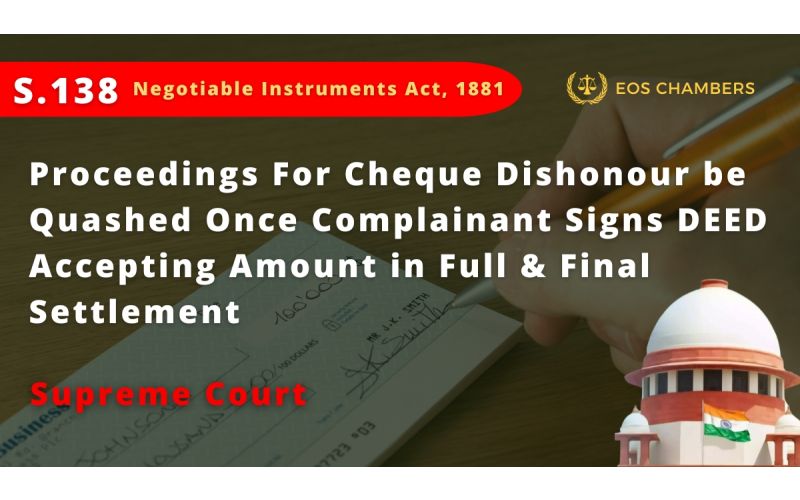
S.138 NI Act | Proceedings For Cheque Dishonour Need To Be Quashed Once Complainant Signs Deed Accepting Amount In Final Settlement : Supreme Court
|
In a Criminal Appeal arising out of proceedings under Section 138 of the Negotiable Instruments Act, 1881, the Supreme Court has ruled that once the settlement has been arrived at and the complainant has signed the deed, the proceedings under this provision must be quashed.
"Considering the overall facts and circumstances of the case, we are of the view that once the settlement has been arrived at and the complainant has signed the deed accepting a particular amount in full and final settlement of the default amount and the fine amount awarded by the Trial Court, the proceedings under Section 138 of the NI Act need to be quashed," observed the bench of Justices Vikram Nath and Satish Chandra Sharma.
The instant appeal was filed challenging the September 13, 2017, order passed by the High Court of Himachal Pradesh, Shimla Bench. By its impugned order, the High Court had upheld the conviction of the accused persons/ the present petitioners under Section 138 of the N.I. Act.
However, in the meantime, a compromise deed was entered between the parties. As per this deed, the respondent-complainant agreed to accept a certain amount as full and final settlement of the cheque amount and the fine imposed by the Trial Court and confirmed by the High Court.
Post Categories
Featured Posts





Latest Posts








Latest Posts

Cross-Border Succession Planning: What Global Indian Families Must Fix in 2026
Protecting Wealth Across Borders Requires More Than Just a Will. Global Indian families are increasingly building wealth beyond geographical boundaries. A business in India, investment portfolios in the UAE, real estate in the UK, children settled in the United States, ...
SC On Aadhaar: Important Takeaways From The Recent Verdict
The Supreme Court ruled that Aadhaar, the ambitious public scheme that uses biometric data to generate unique identification numbers for citizens, is constitutionally valid, but with conditions. Here are the key takeaways from today’s verdict. Read More >

Contract Law in the Digital Age: How E-Contracts Are Transforming Legal Agreements
In today's fast-paced, technology-driven world, traditional paper-based contracts are swiftly being replaced by electronic contracts, or e-contracts. This shift is transforming the way legal agreements are created, executed, and enforced. Here’s an in-depth look at how e-contracts are revolutionizing contract ...
Maternity Benefits Must Be Granted Even If Period Of Benefit Overshoots Term Of Contractual Employment: Supreme Court
The Supreme Court on Thursday(17 Aug) held that maternity benefits have to be granted even if the period of benefit overshoots the term of contractual employment. Maternity benefits can travel beyond the term of contractual employment. The court directed the ...
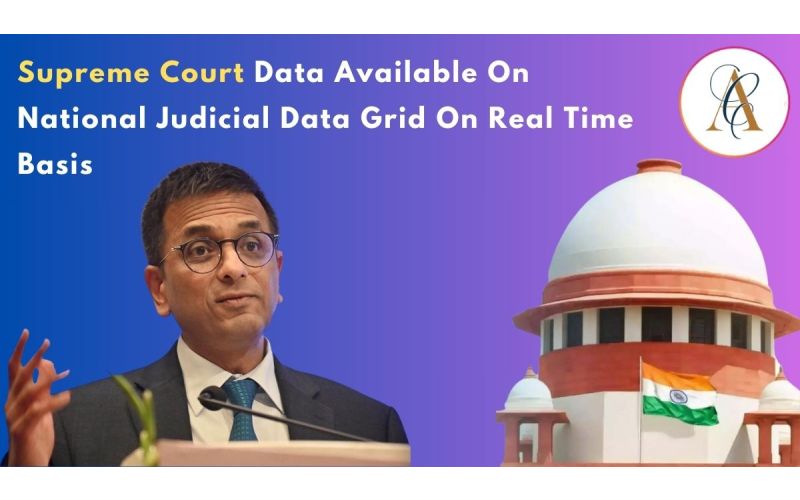
In A First, Supreme Court Data Available On National Judicial Data Grid On Real Time Basis; Boost For Transparency, Says CJI DY Chandrachud
Chief Justice of India DY Chandrachud announced today that the Supreme Court is officially 'onboard' with the National Judicial Data Grid (NJDG) now. The CJI described the onboarding of the Supreme Court data on NJDG portal under the court's 'open ...

Stubble Burning One Reason For Delhi Air Pollution, Says CAQM; Supreme Court Seeks Affidavits From Punjab, Haryana, UP, Rajasthan
The Supreme Court on Tuesday (October 31) asked the Governments of Punjab, Haryana, Uttar Pradesh, Rajasthan and Delhi to file affidavits setting forth the steps they have taken to control air pollution including the measures to curb crop burning. This ...

Speak With Our
Get a Appointment