
Judicial Decorum vs. Legal Expression: Balancing Dissent wit
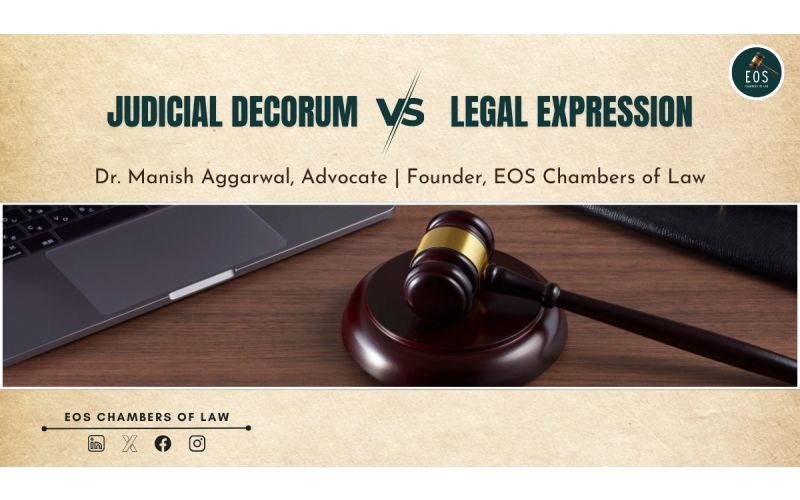
Judicial Decorum vs. Legal Expression: Balancing Dissent with Discipline in India’s Courtrooms
|
🏛️ The Incident That Sparked a National Conversation
The recent events in the Supreme Court of India have reignited a fundamental debate — where does a lawyer’s right to expression end and duty to maintain decorum begin?
A courtroom is not merely a space for argument; it is the sanctum of justice. When emotions overpower ethics, or when disagreement slips into defiance, it threatens not only the dignity of the judiciary but the very foundation of public trust in the justice system.
🗣️ Freedom of Expression: The Lawyer’s Shield
Every advocate has the constitutional right to freedom of speech and expression under Article 19(1)(a) of the Indian Constitution.
However, this right is not absolute — particularly within the court’s precincts, where order, respect, and decorum are vital to the functioning of justice.
Expression in court must serve a constructive purpose — to assist the Bench, to clarify the law, and to represent the client with reasoned persuasion.
But when expression transforms into confrontation, it ceases to be advocacy and becomes disruption.
⚖️ Judicial Decorum: The Cornerstone of Justice
Judicial decorum isn’t about silencing lawyers; it’s about preserving the sanctity of the institution.
As the Supreme Court has observed in Re: Vinay Chandra Mishra (1995), “A lawyer is not merely the mouthpiece of his client but also an officer of the court.”
This dual role demands balance — the advocate must defend fiercely yet speak respectfully, question strongly yet conduct gracefully.
When decorum erodes, justice loses credibility. And in a nation where faith in the judiciary binds democracy together, that loss is too costly to ignore.
🧭 The Role of Bar Councils: Time for Introspection and Reform
India’s Bar Councils must step forward to create clear behavioural and ethical frameworks that protect both —
-
the freedom of expression of advocates, and
-
the disciplinary integrity of the courtroom.
Suggested Guidelines:
-
Revised Code of Conduct: Update the Bar Council of India Rules to define acceptable courtroom expression, distinguishing passion from misconduct.
-
Ethics Refresher Programs: Mandatory annual ethics and courtroom discipline workshops for practising advocates.
-
Swift Disciplinary Review: Establish fast-track grievance mechanisms for courtroom misconduct, ensuring accountability without bias.
-
Dialogue, Not Dictate: Promote regular forums where judges and senior advocates can discuss evolving professional conduct standards.
-
Digital Conduct Policy: In the age of live-streamed hearings, define decorum for digital and hybrid courtroom behaviour.
🌍 Learning from Global Practices
Other jurisdictions — such as the UK and Canada — treat courtroom decorum as a matter of professional identity.
Bar Associations conduct continuous education programs focusing on emotional control, respect for the Bench, and ethical advocacy.
Adopting similar models in India can modernize our legal ethics framework while preserving our rich legal traditions.
💬 Conclusion: The Balance Between Voice and Virtue
True advocacy lies not in raising one’s voice but in raising the quality of one’s reasoning.
A lawyer’s words carry weight only when they are grounded in respect — for the law, for the court, and for the truth.
As members of the Bar, our expression must strengthen justice, not shake its pillars.
Dissent is essential — but dignity must remain inviolable.
#IndianJudiciary #SupremeCourtOfIndia #RuleOfLaw #BarCouncil #Advocacy #LegalEthics #CourtroomDecorum #Justice #DrManishAggarwal #EOSChambers
Post Categories
Featured Posts




Latest Posts








Latest Posts
Inheritance and Succession Laws: What Every NRI Should Know
For Non-Resident Indians (NRIs), navigating inheritance and succession laws in India can be complex. Whether dealing with ancestral property, inheriting assets, or managing family estates, NRIs must understand the legal framework to safeguard their rights and avoid disputes. Here are ...
Supreme Court Issued contempt Notice to Patanjali Ayurved & its MD for Misleading ads On Medicinal Cures
The Supreme Court on Tuesday (February 27) came down heavily on Patanjali Ayurved for continuing to publish misleading advertisements regarding medicinal cures, despite making an assurance to the Court earlier in November last year that no such statements would be ...
DBS Bank Directors Can’t Be Prosecuted For Acts Of Lakshmi Vilas Bank Before Amalgamation : Supreme Court Quashes Criminal Case
The Supreme Court today ruled that DBS Bank and its directors, who were appointed after the amalgamation with Lakshmi Vilas Bank(LVB) and had their appointments approved by the Reserve Bank of India (RBI), cannot be held criminally liable for actions ...

🏠 𝐋𝐞𝐠𝐚𝐥 𝐂𝐡𝐞𝐜𝐤𝐥𝐢𝐬𝐭 𝐁𝐞𝐟𝐨𝐫𝐞 𝐈𝐧𝐯𝐞𝐬𝐭𝐢𝐧𝐠 𝐢𝐧 𝐈𝐧𝐝𝐢𝐚𝐧 𝐑𝐞𝐚𝐥 𝐄𝐬𝐭𝐚𝐭𝐞 (2025 𝐄𝐝𝐢𝐭𝐢𝐨𝐧)
𝐍𝐑𝐈 𝐨𝐫 𝐇𝐍𝐈? 𝐃𝐨𝐧’𝐭 𝐈𝐧𝐯𝐞𝐬𝐭 𝐖𝐢𝐭𝐡𝐨𝐮𝐭 𝐓𝐡𝐞𝐬𝐞 7 𝐋𝐞𝐠𝐚𝐥 𝐂𝐡𝐞𝐜𝐤𝐬! Real estate remains one of the most trusted investment avenues for 𝐍𝐑𝐈𝐬 𝐚𝐧𝐝 𝐇𝐍𝐈𝐬 𝐢𝐧 𝐈𝐧𝐝𝐢𝐚. But with rising frauds, title disputes, and compliance issues—a beautiful property can become a ...
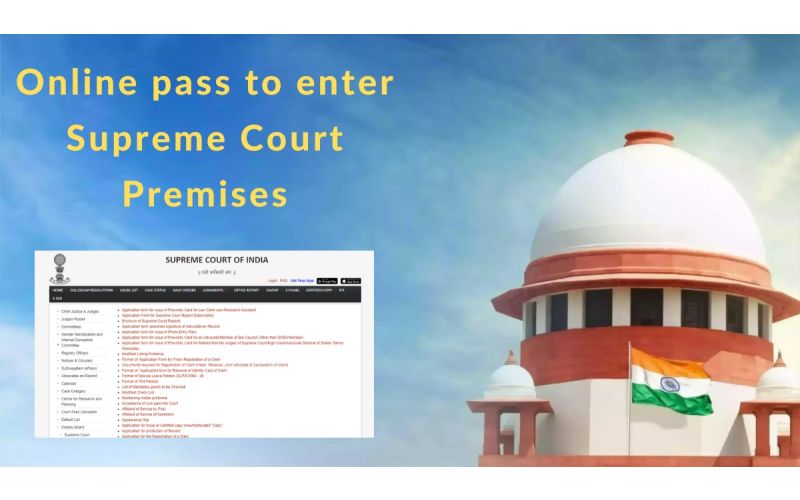
Get Online Pass To Enter Supreme Court Premises
The Supreme Court on Thursday launched ‘SuSwagatam’, a new initiative to generate entry passes online to help those who need to visit the court premises for various purposes. Chief Justice of India (CJI) D Y Chandrachud on Thursday announced the ...

Contract Law in the Digital Age: How E-Contracts Are Transforming Legal Agreements
In today's fast-paced, technology-driven world, traditional paper-based contracts are swiftly being replaced by electronic contracts, or e-contracts. This shift is transforming the way legal agreements are created, executed, and enforced. Here’s an in-depth look at how e-contracts are revolutionizing contract ...

Speak With Our
Get a Appointment