
ADR in Family Law: Benefits and Challenges
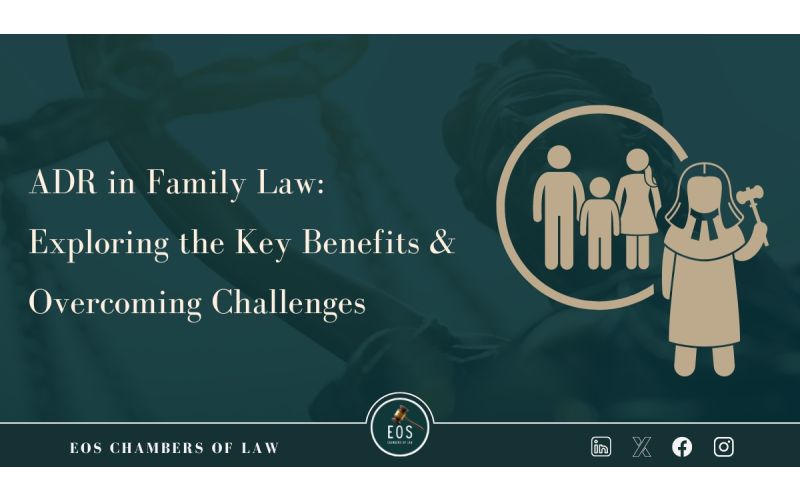
ADR in Family Law: Benefits and Challenges
|
Alternative Dispute Resolution (ADR) has become a pivotal tool in family law, offering a way to resolve disputes without the need for contentious court battles. At Eos Chambers, we've observed the growing reliance on ADR methods such as mediation, arbitration, and collaborative law. Each of these approaches presents unique benefits and challenges, particularly in the sensitive context of family disputes.
🔸 Understanding ADR in Family Law
Family law cases, including divorce, child custody, and property settlements, often involve high emotional stakes. ADR methods aim to address these issues in a more amicable, efficient, and less adversarial manner than traditional litigation. The primary forms of ADR in family law include:
- Mediation: A neutral third party helps the disputing parties reach a mutually agreeable solution.
- Arbitration: A private process where an arbitrator makes binding decisions after considering evidence and arguments.
- Collaborative Law: Both parties and their lawyers agree to resolve disputes through negotiation without going to court.
🔹 Benefits of ADR in Family Law
-
Confidentiality and Privacy: ADR proceedings are typically private, ensuring that sensitive family matters remain confidential. This is crucial in cases involving children, where privacy protection is paramount.
-
Cost-Effective: Traditional litigation can be expensive, with costs accumulating due to prolonged court battles. ADR methods are generally less costly and can be completed more quickly.
-
Flexibility and Control: ADR allows parties to maintain control over the resolution process. Unlike a court decision imposed by a judge, ADR outcomes are typically reached by mutual agreement, resulting in more satisfactory and tailored solutions.
-
Reduced Conflict: Family law disputes can become adversarial, exacerbating tensions between parties. ADR encourages cooperation and communication, reducing animosity and fostering constructive dialogue, especially beneficial in co-parenting situations.
-
Faster Resolution: Court dockets are often congested, leading to delays. ADR can expedite the process, allowing families to move forward without prolonged stress.
🔸 Challenges of ADR in Family Law
-
Imbalance of Power: In some family law cases, significant power imbalances, such as those involving domestic violence, can lead to unfair outcomes if not carefully managed, as the dominant party may exert undue influence.
-
Lack of Formal Discovery: ADR processes like mediation and arbitration typically do not involve formal discovery. This can be a disadvantage if one party has more information, potentially leading to decisions based on incomplete or inaccurate data.
-
No Precedent Value: Unlike court decisions, ADR outcomes do not create legal precedents, which can be a limitation in cases requiring broader legal interpretation.
-
Non-Binding Nature of Mediation: Mediation, while effective, does not result in a binding decision unless the parties reach an agreement. If mediation fails, parties may still need to resort to litigation, incurring additional time and costs.
-
Involvement of Lawyers: In some ADR methods, particularly collaborative law, both parties must be represented by lawyers. While this ensures legal protection, it can increase costs and complicate negotiations if the lawyers adopt adversarial stances.
🔹 Conclusion
ADR offers numerous benefits in family law, including privacy, cost-effectiveness, and faster resolutions. However, challenges such as power imbalances and the potential lack of binding outcomes require careful consideration. At Eos Chambers, we advocate for ADR as a valuable tool in family law, but emphasize the importance of choosing the right method and ensuring both parties are fully informed and fairly represented. ADR remains a vital option for families seeking to resolve disputes with dignity and respect.
Post Categories
Featured Posts








Latest Posts








Latest Posts

Legal Framework for Virtual Court Hearings: Challenges and Opportunities
The advent of virtual court hearings marks a significant evolution in the judicial system, reshaping traditional courtroom dynamics. While this shift brings efficiency and accessibility, it also introduces unique challenges and opportunities that require careful consideration within the legal framework. ...
How Mediation Works: Step-by-Step Process for Businesses
𝐌𝐞𝐝𝐢𝐚𝐭𝐢𝐨𝐧 is no longer just an option—it’s becoming the preferred method for Indian businesses to resolve disputes quickly and professionally. From vendor conflicts and payment delays to joint venture disagreements, mediation offers a structured, confidential, and relationship-focused approach that helps companies ...

Legal Challenges in Cryptocurrency and Blockchain: Exploring the Evolving Legal Landscape
The rise of cryptocurrencies and blockchain technology has revolutionized the financial world, but it has also brought about a series of complex legal challenges. As more businesses and individuals adopt digital currencies and decentralized systems, governments and regulatory bodies are ...

Muzaffarnagar slapping case: SC pulls up UP govt over delay in student counselling
After perusing the state reply Friday, the bench said it reflected that the counselling process had not been done yet. “It is not reflected, it is not being done,” said Justice Oka. The Supreme Court Friday pulled up the Uttar ...

ED Summons Under PMLA: What to Do and What Not to Do (Complete Legal Guide)
Receiving a summons from the Enforcement Directorate (ED) under the Prevention of Money Laundering Act, 2002 (PMLA) can be intimidating. For many individuals—business owners, directors, promoters, professionals, or even family members—an ED summons creates panic, confusion, and fear of arrest. ...

75% Eligibility Condition For Admission To Sports Quota ‘Unwarranted & Discriminatory
The Supreme Court has held that the eligibility condition of minimum 75% marks does not promote the object of introducing the sports quota, and such criterion subverts the object and falls afoul of the equality clause in Article 14 of ...

Speak With Our
Get a Appointment