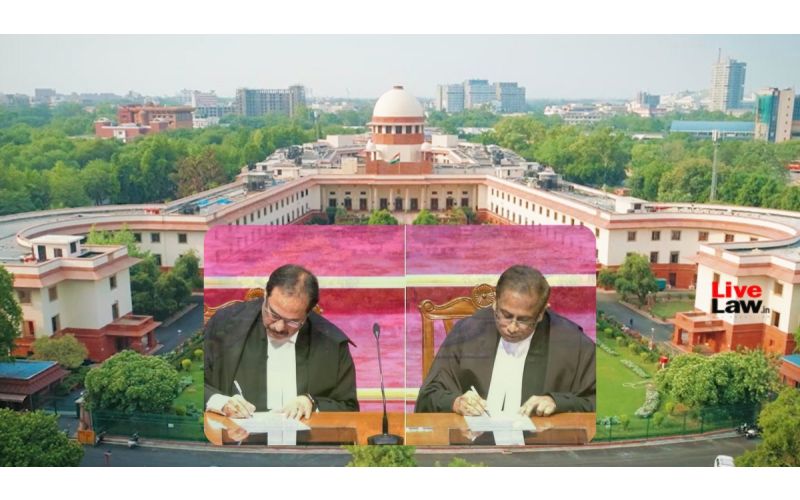
By India, Today News Desk: Justice Prashant Kumar Mishra and senior advocate KV Viswanathan were sworn-in as Supreme Court judges on Friday, a day after the Central government cleared the appointment of the advocates.
New Union Law Minister Arjun Meghwal took to Twitter to confirm the appointment of Justices Mishra and Viswanathan. Their names were recommended to the Centre by the Supreme Court Collegium, headed by Chief Justice of India (CJI) DY Chandrachud.
The five-member Collegium said the Supreme Court has a sanctioned strength of 34 judges and is currently functioning with 32. Two Supreme Court judges — Dinesh Maheshwari and MR Shah — retired recently.
Four more vacancies will arise by the second week of July and the working strength of judges will further come down, the collegium noted as it recommended the names of Justices Viswanathan and Mishra on Tuesday.
Read More
In a Criminal Appeal arising out of proceedings under Section 138 of the Negotiable Instruments Act, 1881, the Supreme Court has ruled that once the settlement has been arrived at and the complainant has signed the deed, the proceedings under ...
The Supreme Court on Monday (30th October) held that an insurance company cannot claim that it is not liable to pay compensation in a motor vehicle accident claim just because the vehicle owner did not verify the genuineness of the ...
In today's rapidly changing world, environmental and sustainability law has become a cornerstone of global legal practices. With increasing awareness of climate change, resource depletion, and environmental degradation, these laws are essential for promoting sustainable development and protecting our planet ...
The General Data Protection Regulation (GDPR) remains a cornerstone of data protection in the EU. Since its implementation in 2018, several updates have refined its application, addressing evolving data privacy concerns. For solicitors, understanding these changes is crucial for advising ...
The Supreme Court has said a five-judge constitution bench will examine whether Parliament can “abrogate the constitutional principles of governance” for the Delhi government by making a law to take away its control over services. The Centre recently issued an ...
The Indian Penal Code (IPC) is the official criminal code of India. It is a comprehensive code intended to cover all substantive aspects of criminal law. The code was drafted on the recommendations of the first law commission of India ...