
Marriages Don’t Require Public Declaration: SC
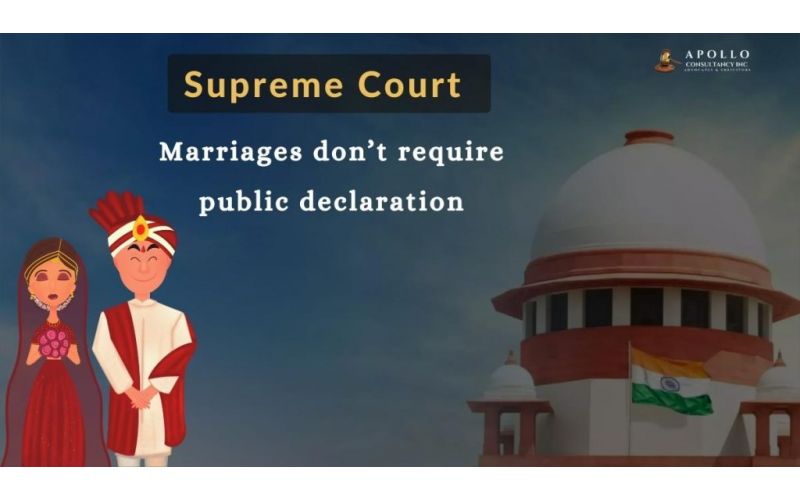
Marriages Don’t Require Public Declaration: SC
|
The Supreme Court of India has ruled that not all marriages require a public declaration or solemnisation
Not every valid marriage requires a public declaration or solemnisation in a particular manner, the Supreme Court held on Monday, as it underlined the importance of autonomy in choosing life partners and approved a Tamil Nadu law that allowed “self-respect” marriages.
“Couples intending to marry may refrain from making a public declaration due to various reasons, such as familial opposition or fear for their safety. In such cases, enforcing a public declaration could put lives at risk and potentially result in forced separation,” noted a bench of justices S Ravindra Bhat and Aravind Kumar.
Section 7-A of the Hindu Marriage Act, as applicable to the state of Tamil Nadu through a state amendment in 1967, legally recognises Suyamariyathai and Seerthiruththa marriages (reformist or self-respect marriages) between any two Hindus, solemnised in the presence of relatives, friends, or other persons.
The state law maintains that the parties to the marriage can proclaim in whatever language they understand that one person accepts the other to be his or her wife or husband; the parties can also garland each other, place rings on each other’s fingers, or tie the thali to solemnise the union, as per the law.
By a judgment on May 5, the Madras high court had disapproved of marriages being conducted by advocates in their offices under Section 7-A of HMA, citing a 2014 judgment of the same high court. It added that the marriage performed by advocates in their office is not valid, unless it is registered under the Tamil Nadu Registration of Marriages Act, 2009. The court further said that the physical appearance of the parties to the marriage before the marriage registrar is essential.
The high court judgment came while dismissing a habeas corpus petition filed by a man, who complained that his wife, with whom he was married in a ceremony before advocates, was forcibly taken away by her parents. The man filed an appeal against this order through advocates A Velan and Mrityunjay Pathak.
Setting aside the high court judgment, the top court on Monday banked on a 2001 judgment of the Supreme Court that held that the presence of a priest was not necessary for a valid marriage under Section 7-A and that a wedding conducted in the presence of relatives or friends or other persons by a simple ceremony was enough.
“The view expressed by the Madras high court in Balakrishnan Pandiyan Case (2014) is erroneous. It is premised on the assumption that each marriage requires a public solemnisation or declaration. Such a view is rather simplistic because often due to parental pressure, couples intending to enter into matrimony may not enter into it for the reason of such opposition, hold or give such public declaration, as doing so would imperil their lives and could very likely result to threat of bodily integrity, or forcible or coerced separation,” noted the bench.
It is not hard to visualise other pressures brought to two individuals who are otherwise adults and possess free will, said the court, adding the 2014 judgment of the Madras high court is not only narrowing the otherwise wide import of statute but is also violative of the right under Article 21 of the Constitution.
The court went on to cite a bundle of top court judgments that acknowledged the right to choose a life partner as a fundamental right under Article 21. It referred to the Supreme Court judgment in the 2017 Shafin Jahan-Hadiya case, emphasising that the personal liberty of a person must be fully given effect to.
It said that lawyers who are not acting in the capacity of the officer of the court, but in other capacities like that of a friend or relative or social activist can perform marriages under Section 7-A of HMA. “Advocates have many capacities. They are officers of the court. While acting as counsel/advocate, they should not undertake or volunteer to solemnise marriages. However, in their private capacity as friends as relatives, their roles as witnesses cannot be ruled out,” it stated.
In the present case, the bench recorded the wishes of the woman that she wanted to live with the petitioner and allowed the man’s plea.
Post Categories
Featured Posts







Latest Posts








Latest Posts

Legal Challenges in Cryptocurrency and Blockchain: Exploring the Evolving Legal Landscape
The rise of cryptocurrencies and blockchain technology has revolutionized the financial world, but it has also brought about a series of complex legal challenges. As more businesses and individuals adopt digital currencies and decentralized systems, governments and regulatory bodies are ...

5 Mistakes People Make While Buying Property in India
Buying property is one of the biggest financial decisions in India.But are you sure you are not making a mistake that could cost you years of litigation or financial loss? Many buyers focus only on location and price, while ignoring ...
Maternity Benefits Must Be Granted Even If Period Of Benefit Overshoots Term Of Contractual Employment: Supreme Court
The Supreme Court on Thursday(17 Aug) held that maternity benefits have to be granted even if the period of benefit overshoots the term of contractual employment. Maternity benefits can travel beyond the term of contractual employment. The court directed the ...
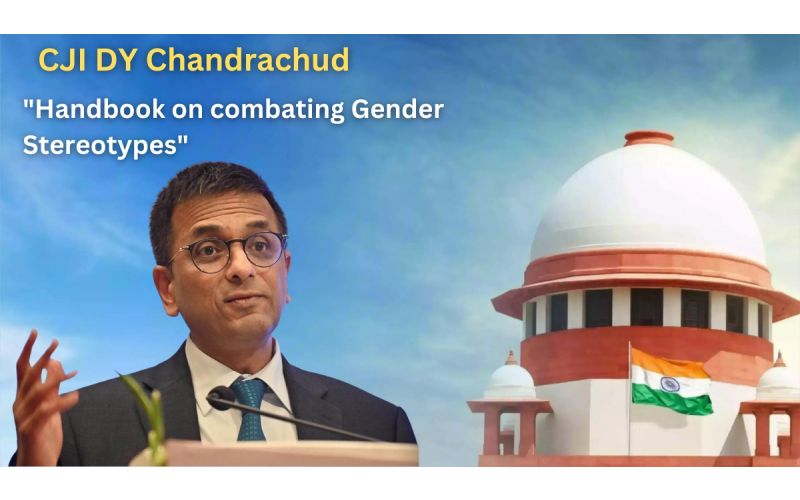
Supreme Court Has Prepared A “Handbook On Combating Gender Stereotypes”
Chief Justice of India DY Chandrachud announced today morning that the Supreme Court has prepared a “Handbook on combating Gender Stereotypes”, in order to identify and remove the use of words and phrases, which are loaded with gender stereotypes, in ...
Supreme Court Sides With Madras HC: Person Forwarding Social Media Messages Liable For Contents
The Madras High Court had noted that Shekher was a person of high stature and had many followers. It stated that he should have exercised more caution when forwarding messages. The Supreme Court refused to entertain an appeal challenging Madras ...
Remote Work and Employment Law in India: Navigating Legal Implications for Employers and Employees
Remote Work and Employment Law in India: Navigating Legal Implications for Employers and Employees The rise of remote work, accelerated by the COVID-19 pandemic, has fundamentally changed the way businesses operate and employees engage with their work. While remote work ...

Speak With Our
Get a Appointment