
Cheque Bounce Case Can Be Quashed U/S 482 Only If Amount Is
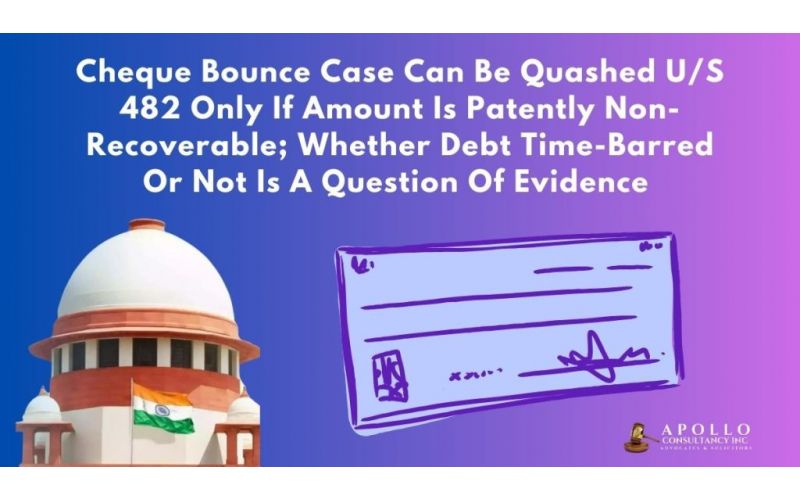
Cheque Bounce Case Can Be Quashed U/S 482 Only If Amount Is Patently Non-Recoverable; Whether Debt Time-Barred Or Not Is A Question Of Evidence : SC
|
The Supreme Court observed that the question whether a cheque was issued towards a time barred debt is to be decided on evidence.
“It is only in cases wherein an amount which is out and out non-recoverable, towards which a cheque is issued, dishonoured and for recovery of which a criminal action is initiated, the question of threshold jurisdiction will arise. In such cases, the Court exercising jurisdiction under Section 482 CrPC will be justified in interfering but not otherwise”, the bench of Justices AS Bopanna and Prashant Kumar Mishra said.
In this case, the Andhra Pradesh High Court quashed a cheque bounce complaint on the ground that the prosecution was not in respect of a legally recoverable debt.
In appeal, the court referred to its earlier judgments (S. Natarajan vs. Sama Dharman & Anr. (2021) 6 SCC 413 and A.V. Murthy vs. B.S Nagabasavanna (2002) 2 SCC 642) that explained the scope of consideration in a petition filed under Section 482 of CrPC seeking quashment of a complaint filed under Section 138 of NI Act.
“It is crystal clear that this Court keeping in perspective the nature of the proceedings arising under the NI Act and also keeping in view that the cheque itself is a promise to pay even if the debt is barred by time has in that circumstance kept in view the provision contained in Section 25(3) of the Contract Act and has indicated that if the question as to whether the debt or liability being barred by limitation was an issue to be considered in such proceedings, the same is to be decided based on the evidence to be adduced by the parties since the question of limitation is a mixed question of law and fact. It is only in cases wherein an amount which is out and out non-recoverable, towards which a cheque is issued, dishonoured and for recovery of which a criminal action is initiated, the question of threshold jurisdiction will arise. In such cases, the Court exercising jurisdiction under Section 482 CrPC will be justified in interfering but not otherwise. In that light, this Court was of the view that entertaining a petition under Section 482 CrPC to quash the proceedings at the stage earlier to the evidence would not be justified.”, the court said.
Though it was contended that the cheque is issued in respect of the debt which is not enforceable or a liability which cannot be recovered, in such event, the presumption under Section 139 of NI Act would not be available, the bench observed;
“We do not see the need to tread that path to undertake an academic exercise on that aspect of the matter, since from the very facts involved in the case on hand ex facie it indicates that the claim which was made in the complaint before the Trial Court based on the cheque which was dishonoured cannot be construed as time-barred and as such it cannot be classified as a debt which was not legally recoverable.”
The court noted that in the instant case not only the amount was a legally recoverable debt which is evident on the face of it, the complaint was also filed within time. Therefore, it set aside the High Court judgment and restored the complaint.
If the question as to whether the debt or liability being barred by limitation was an issue to be considered in such proceedings, the same is to be decided based on the evidence to be adduced by the parties since the question of limitation is a mixed question of law and fact. It is only in cases wherein an amount which is out and out non-recoverable, towards which a cheque is issued, dishonoured and for recovery of which a criminal action is initiated, the question of threshold jurisdiction will arise. In such cases, the Court exercising jurisdiction under Section 482 CrPC will be justified in interfering but not otherwise.
Post Categories
Featured Posts





Latest Posts








Latest Posts
AI & the Judiciary: Boundaries and Risks
🧠 Introduction: A New Era for Justice Artificial Intelligence (AI) has rapidly entered almost every professional domain — and the legal world is no exception. From predictive analytics to legal research automation, AI is revolutionizing how lawyers, judges, and courts ...
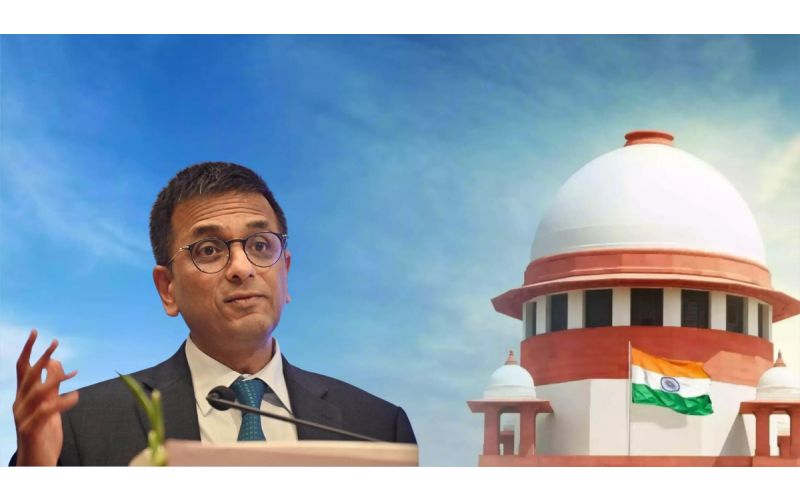
CJI DY Chandrachud Cautions About Artificial Intelligence; Says It Can Make Biased Decisions Based On Societal Prejudices
Chief Justice of India D Y Chandrachudrecently spoke on how no technology is neutral and how it can reflect human values when deployed in the real world. The CJI spoke on how one must ponder the human and societal values ...
Elevate Your Legal Strategy with Expert Witness Preparation Support
Introduction: In the realm of legal proceedings, witness testimony can make or break a case. It's the narrative that often tips the scales of justice. Yet, preparing witnesses for the courtroom is a nuanced art—one that demands expertise, strategy, and ...

Protecting Confidentiality: A Legal Guide to Non-Disclosure Agreements (NDAs) in India
In a rapidly growing business ecosystem, safeguarding sensitive information is paramount. For Indian businesses, Non-Disclosure Agreements (NDAs) have become crucial legal tools to protect trade secrets, proprietary information, client details, and more. This article explores NDAs from an Indian legal ...
ADR in Real Estate & Construction Disputes | Fast-Track Legal Solutions
The real estate and construction sector in India is one of the fastest-growing industries, but it is also one of the most dispute-prone. Delays in possession, payment disputes, contractor disagreements, quality issues, and non-compliance with project timelines often lead to ...
SC On Aadhaar: Important Takeaways From The Recent Verdict
The Supreme Court ruled that Aadhaar, the ambitious public scheme that uses biometric data to generate unique identification numbers for citizens, is constitutionally valid, but with conditions. Here are the key takeaways from today’s verdict. Read More >

Speak With Our
Get a Appointment