
Motor Accident Claims – Social Status Of Deceased To Be Co
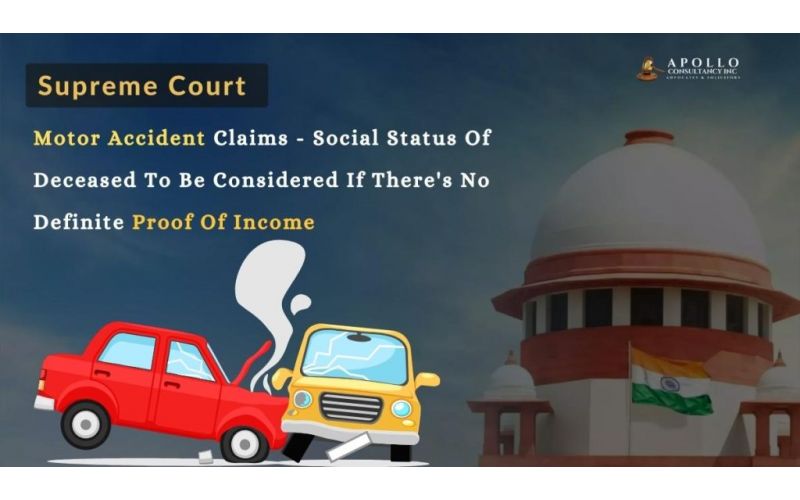
Motor Accident Claims – Social Status Of Deceased To Be Considered If There’s No Definite Proof Of Income: Supreme Court
|
The Supreme Court has reinstated an award originally granted by the Motor Accidents Claim Tribunal (MACT). The apex court expressed disappointment over the approach taken by the High Court in evaluating the evidence and reinstated the MACT’s verdict.
The Court observed “It is unfortunate that in a case of the present nature, the High Court while assessing the evidence available on record, has sought to seek strict evidence with regard to the income of the deceased. In a matter of the present nature where compensation is sought and even in the absence of definite proof of the income, the social status of the deceased is to be kept in perspective where such persons are employed in unorganized sector and the notional income, in any event, is required to be taken into consideration. More so in a circumstance, where the MACT had referred to the evidence available on record and then arrived at its conclusion, the re-appreciation of evidence by the High Court is without being sensitive to nature of lis before it.”
The Supreme Court bench comprising Justices A.S. Bopanna and Justice Prashant Kumar Mishra was hearing an appeal against HC judgment which had reduced the amount of compensation from Rs 11,87,000 to 4,75,000 to claimants in a motor accident case.
The case pertained to the untimely demise of an individual who was the sole earning member of his family. The High Court’s approach to evaluating the evidence regarding the deceased’s income had raised concerns, as the claimants were unable to secure comprehensive documentation due to the deceased’s employment status in the unorganized sector.
Despite this challenge, the MACT had made efforts to assess the deceased’s income and concluded that he was working as a skilled mechanic in a two-wheeler repair shop.
In its judgment, the Supreme Court highlighted that when dealing with cases involving individuals employed in the unorganized sector, it is crucial to consider the notional income based on their social status. The Court emphasized that even in the absence of concrete proof of income, the notional income should be taken into account, especially when the claimants are dependents of the deceased.
The Supreme Court criticized the High Court’s strict approach in seeking exhaustive evidence of the deceased’s income and ownership of the repair shop where he worked.
The Court emphasized that the nature of cases involving the unorganized sector requires sensitivity and consideration of the deceased’s social circumstances.
Consequently, the Supreme Court set aside the judgment issued by the High Court on March 5, 2019, and restored the Award originally granted by the MACT on March 13, 2007. The Court directed the Insurance Company to deposit the awarded amount within four weeks from the date of receipt of the judgment.
Post Categories
Featured Posts



Latest Posts








Latest Posts

75% Eligibility Condition For Admission To Sports Quota ‘Unwarranted & Discriminatory
The Supreme Court has held that the eligibility condition of minimum 75% marks does not promote the object of introducing the sports quota, and such criterion subverts the object and falls afoul of the equality clause in Article 14 of ...

Adoption Rights for LGBTQ+ Couples: Legal Challenges in India
We recognize that the right to adopt is one of the most debated and sensitive issues for LGBTQ+ couples in India. Despite increasing societal awareness and progressive judicial rulings, the Indian legal framework still presents substantial challenges for LGBTQ+ individuals ...
Cheque Bounce Case Can Be Quashed U/S 482 Only If Amount Is Patently Non-Recoverable; Whether Debt Time-Barred Or Not Is A Question Of Evidence : SC
The Supreme Court observed that the question whether a cheque was issued towards a time barred debt is to be decided on evidence. “It is only in cases wherein an amount which is out and out non-recoverable, towards which a ...
Transfer Of Property Act | Rents Receivable Can Be Assigned By Debtor To Creditor As Actionable Claim: Supreme Court
Rents receivable by a borrower can be assigned to a lender as an "actionable claim" as per the Transfer of Property Act,1882(TPA), held the Supreme Court while deciding a dispute between the Infrastructure Leasing and Financial Services Ltd and the ...
'Serving Personnel Can't Be Deemed To Ex-Servicemen From Future Date' : Supreme Court Rejects Army Veterans Plea For Govt Job
Serving Armed Forces officers can't be deemed to be Ex-Servicemen from a prospective date, said the Supreme Court while rejecting the claim of three appellants for appointments as Village Development Officers in the Uttar Pradesh State Service. The appellants, even ...
"Why Is CARA Delaying Adoption Process?" Supreme Court Calls For Prompt Action To Benefit Waiting Children & Couples
The Supreme Court on Friday (13.10.2023), raised serious concerns over the delays in the adoption process and the potential impact on both aspiring parents and children in need of loving homes. The remarks came from a bench comprising CJI DY ...

Speak With Our
Get a Appointment